


You reach for the milk and feel your fingers slide across a shelf slick with water. Below it, a thin sheet of ice has crept across the bottom of the crisper drawer, and the produce sitting in it has gone soft. A refrigerator leaking water inside rarely announces itself. It builds quietly for weeks until warped floorboards, ruined groceries, or a puddle spreading across your kitchen tile force you to notice.
Our appliance experts at East Coast Appliance have traced this exact problem across every major brand for more than three decades. We built this guide to walk you through the five most common causes in the order you should check them, the troubleshooting steps that solve most cases without a service call, the point at which repair stops making financial sense, and the refrigerator replacement models we recommend most often.
Browse Top Refrigerator Models
Don't let a leaking fridge ruin your groceries or your floors. Shop East Coast Appliance for reliable refrigeration at the lowest prices in Virginia.
Shop RefrigeratorsKey Takeaways
- Start With the Drain: A clogged defrost drain is the single most common cause of water pooling inside a refrigerator.
- Check the Seal: A worn door gasket lets warm, humid air in, and that condensation shows up as water on the shelves.
- Isolate the Ice Maker: Shutting off the water supply for a day tells you immediately whether the water line is your culprit.
- Know When to Stop: Once a refrigerator passes ten to twelve years, replacement usually costs less than repeated repairs.
Understanding the Causes of Internal Refrigerator Leaks
The first step is answering the question, "Why is my refrigerator leaking water?" Get to the source and the fix usually becomes obvious. There are several places water can escape inside a fridge, so work through them in order from simplest to most involved:
- Clogged Defrost Drain: Food debris and ice block the drain, so meltwater pools inside instead of exiting to the pan below.
- Damaged or Blocked Drain Pan: The pan beneath the unit normally holds a little water, but cracks let it escape onto your floor.
- Faulty Door Gasket: A worn seal admits warm air, which condenses on cold surfaces and melts ice buildup.
- Improper Temperature Settings: Settings that are too cold create excess frost, and a power outage can melt accumulated ice all at once.
- Broken Water Filter or Water Line: On units with an ice maker, a cracked filter housing or loose supply line leaks quietly behind the interior panels.
Clogged Defrost Drains and Ice Buildup
Every frost-free refrigerator runs a defrost cycle several times a day, melting frost off the evaporator coils and sending that water down a small drain tube into a pan near the compressor. That tube is narrow, and it clogs. Food particles, mold, and refrozen ice plug the opening until meltwater has nowhere to go but back into the fresh food compartment.
The telltale sign is water collecting under the crisper drawers, often with a thin sheet of ice at the very back of the freezer floor. Flushing the drain with warm water and a turkey baster clears most clogs. If ice has fully sealed the tube, unplug the unit and let it thaw for several hours before flushing.
Our service technicians recommend cleaning the defrost drain every six months, and more often if you store a lot of unwrapped produce.
Worn Door Gaskets and Condensation Problems
The rubber gasket around your door is the only barrier between cold interior air and your humid kitchen. As it ages it hardens, cracks, and loses the magnetic grip that pulls the door tight. Warm air seeps in continuously, condenses on the cold interior walls, and runs down onto the shelves.
Test it in seconds. Close the door on a dollar bill and pull. If the bill slides out with almost no resistance, the seal at that spot has failed. Repeat the test at several points around the frame, paying attention to the bottom corners where gaskets wear first. Also check that the door is not being held slightly ajar by an overfilled shelf or a misaligned bin.
Cracked Drain Pans and Water Under the Unit
If the water is appearing on the floor rather than the shelves, the drain pan is a prime suspect. It sits underneath the refrigerator and is designed to hold defrost water until the compressor's heat evaporates it. A cracked pan, or one knocked out of position when the fridge was last moved, dumps that water straight onto your flooring.
Pull the unit forward, remove the lower rear or front access panel, and slide the pan out. Look for hairline cracks along the bottom seams and confirm the pan sits level and fully seated beneath the drain outlet. A pan that is simply overflowing rather than cracked usually signals a blocked condenser fan or a defrost system running far too often.
Ice Maker Water Lines and Filter Housings
Any refrigerator with an ice maker or water dispenser has a plastic supply line running from your household plumbing into the door and up to the reservoir. These lines crack with age, work loose at their push-fit connections, and freeze solid when the freezer runs too cold. The filter housing is another frequent offender, especially right after a filter change when the cartridge was not seated correctly.
Isolation is the fastest diagnostic. Turn off the water supply valve behind the refrigerator, switch off the ice maker, and dry the interior completely. If no new water appears over the next day, you have found your source. If water still collects, the leak is coming from the defrost system instead.
Temperature Settings and Power Interruptions
Sometimes the fix costs nothing. A freezer set far colder than necessary produces heavy frost that overwhelms the defrost drain. A refrigerator compartment set too warm allows condensation to form on interior surfaces. Aim for 37°F in the fresh food section and 0°F in the freezer.
A power outage is worth ruling out too. If the unit lost power for several hours, accumulated freezer ice may have partially melted and run forward into the cabinet. Dry everything thoroughly, restore power, and watch for a day before assuming a component has failed.
Read more:
- Refrigerator Replacement Parts to Fix Your Fridge
- How To Get Rid of Smell In Fridge: Fridge Deodorizer
Leak Sources Head-to-Head Diagnosis Comparison
| Leak Source | What You Will Notice | Typical Fix |
|---|---|---|
| Clogged Defrost Drain | Water under the crisper drawers and ice at the back of the freezer floor. | Flush the drain tube with warm water after thawing any ice. |
| Worn Door Gasket | Condensation beading on interior walls and frost near the door frame. | Replace the gasket or realign a door that no longer closes flush. |
| Cracked Drain Pan | Water pooling on the floor beneath or behind the unit. | Replace the pan and confirm it seats level under the drain outlet. |
| Ice Maker Water Line | Leaks near the dispenser, filter housing, or door hinge area. | Reseat or replace the supply line and confirm the filter is locked in. |
| Temperature Settings | Heavy frost buildup with no visible damage anywhere. | Reset to 37°F fresh food and 0°F freezer, then monitor for a day. |
Step-by-Step Troubleshooting Guide
When you first notice your refrigerator leaking water inside, do not assume the worst. Most cases are not complex or expensive. Follow these steps to troubleshoot the issue, starting with the simplest possibilities. Unplug the unit before reaching behind panels or into the drain area.
- Check the Temperature: Confirm the settings have not been bumped and that an independent thermometer matches the display reading.
- Inspect the Door Seals: Run the dollar bill test around the full perimeter of both doors and look for hardened or torn gasket sections.
- Clear the Defrost Drain: Locate the drain opening at the back of the freezer floor and flush it with warm water until it runs freely.
- Examine the Drain Pan: Pull the unit forward, slide the pan out, and check for cracks, debris, and proper seating.
- Turn Off the Water and Ice Maker: Shut the supply valve, dry the interior, and wait a day. Continued leaking rules the ice maker out.
- Clean the Condenser Coils: Vacuum the coils at the back or underneath, since restricted airflow forces excess frost and defrost cycling.
If you are unsure how to locate any of these components, your user manual has a labeled diagram for your specific model. Work through the list in order rather than jumping ahead, because the early steps are free and resolve the majority of leaks.
Additional Preventive Maintenance Tips
Once you have stopped the leak, a handful of good habits will keep it from coming back:
- Clean the defrost drain every six months to prevent clogs before they start.
- Check the door gasket monthly and wipe it with warm soapy water to keep the rubber pliable.
- Verify the internal temperature against a separate thermometer, since a mismatch points to a failing thermostat.
- Wipe down the interior monthly to remove stray food particles that migrate into the drain.
- Vacuum the condenser coils twice a year so the compressor is not working harder than it needs to.
- Replace the water filter on schedule and confirm it locks fully into the housing.
When to Call a Professional
Bring in a repair expert if you have worked through every troubleshooting step and water keeps appearing. That pattern usually means a failed defrost heater, a bad thermostat, or a sealed system problem, none of which are homeowner repairs.
Call immediately if the water is anywhere near electrical components, the compressor, or a wiring harness. Water and live circuits are not a combination to investigate on your own.
It is also perfectly reasonable to call simply because you would rather not do it yourself. Tell the technician what you have already ruled out, and they can move straight to the real fault. A proper repair extends the life of your refrigerator far better than a temporary patch that fails again in a few weeks.
The Pros and Cons of Repairing a Leaking Refrigerator
Clearing a defrost drain or replacing a gasket is genuinely worth doing yourself, but there is a point where repair stops being the smart financial choice. Weighing both sides helps you decide whether to grab a turkey baster or start shopping.
Pros
Very Low Cost
Flushing a drain or reseating a filter costs nothing beyond warm water and a few towels.
Fast Resolution
Most drain and gasket fixes take under an hour with no waiting on a service appointment.
Prevents Water Damage
Acting immediately stops water from reaching flooring, subfloor, and nearby cabinetry.
Useful Diagnosis
Ruling out simple causes gives your technician a head start if real repair work is needed.
Cons
Repeat Failures on Old Units
Past ten years, one repaired component is often followed quickly by the next one failing.
Electrical and Water Hazards
Defrost heaters and wiring sit close to standing water, so power must be off at the outlet.
Hidden Damage
Slow leaks behind the unit quietly warp flooring and grow mold while you troubleshoot.
No Efficiency Gain
A repair restores old performance without the energy savings a newer model delivers.
Best Refrigerator Replacements for Quality and Value
Homeowners can often fix a leaking fridge themselves or call a professional for help. But persistent leaks on an aging unit, especially alongside rising energy bills or inconsistent cooling, usually signal that replacement is the better investment. If repairs are not enough, these four models are the ones our team recommends most.
Frigidaire Professional 36 in. 22.6 Cu. Ft. Stainless Steel Counter Depth French Door Refrigerator
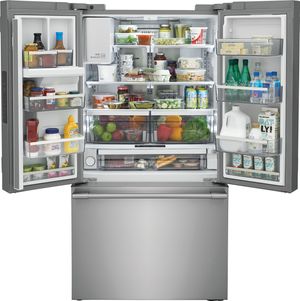
This Frigidaire counter depth refrigerator is an excellent place to start your search. CrispSeal drawers hold humidity at the right level so produce stays firm for days longer than it would on an open shelf. The SpaceWise interior layout is designed so nothing disappears behind something else, including the leftovers pushed to the back. The counter-depth body sits flush with standard cabinetry, which opens up walking space in a narrow kitchen. Soft-close doors and a smudge-resistant finish make it forgiving in a household with kids.
Top Features
- CrispSeal Drawers: Maintain optimal humidity to keep produce fresh noticeably longer.
- SpaceWise Organization: Adjustable shelving and bins keep every item visible and reachable.
- Dual Ice Makers: Two ice systems keep up with entertaining and daily family use.
⭐ Featured Frigidaire Refrigerator #PRFC2383AF Review:"So incredibly happy with our new fridge, has all the space that we need to accommodate everything we use. The doors are slow and self-closing which is nice with kids as well as smudge resistant. The double ice maker is definitely a bonus!"
GE 36 in. 21.9 Cu. Ft. Stainless Steel Counter Depth Side By Side Refrigerator

This GE side-by-side refrigerator puts water and ice on the outside of the door, so nobody opens the fridge to fill a glass. Soft LED lighting reaches the corners instead of leaving the back half in shadow. The spillproof shelves have a raised edge that contains a knocked-over juice carton rather than letting it run down onto the shelf below, which is a meaningful feature in a house with young kids. A door alarm sounds if the door has been left open too long, ending one of the most common causes of frost buildup and condensation.
Top Features
- External Water and Ice: Dispenses through the door so cold air stays inside the cabinet.
- Spillproof Shelves: Raised edges contain spills instead of letting them cascade downward.
- Door Alarm: Alerts you when a door is left ajar, preventing frost and condensation problems.
⭐ Featured GE Refrigerator #GZS22DSJSS Review:"It has exceeded all expectations! Quiet, excellent interior design that maximizes space, deep humidifier drawer for vegetables, convenient slide-out shelves, and soft lights."
Café 36 in. 22.3 Cu. Ft. Platinum Glass Counter Depth French Door Refrigerator
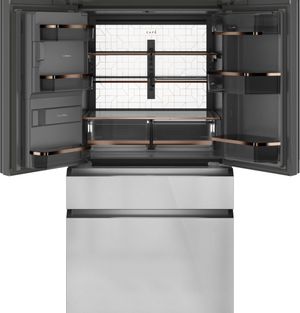
A failed refrigerator is an opening to genuinely upgrade the room, and this Café counter-depth refrigerator is where to spend it. The middle drawer holds its own temperature independent of the fridge and freezer, so you can chill wine properly or stage a charcuterie board the night before a party. Hands-free AutoFill lets you set a pitcher under the dispenser and walk away. The platinum glass exterior resists fingerprints far better than brushed steel and reads as a design element rather than an appliance.
Top Features
- Independent Temperature Drawer: Runs at its own setting for beverages, deli items, or party prep.
- Hands-Free AutoFill: Fills a pitcher or bottle to the right level without you standing there.
- Platinum Glass Finish: Genuinely fingerprint-resistant and a visual step above standard stainless.
⭐ Featured Café Refrigerator #CXE22DM5PS5 Review:"I love the backlight inside the fridge and the auto water fill. It's truly fingerprint-resistant and has ample space. It also has great features, and I couldn't be happier."
LG 30 in. 21.8 Cu. Ft. Stainless Steel French Door Refrigerator
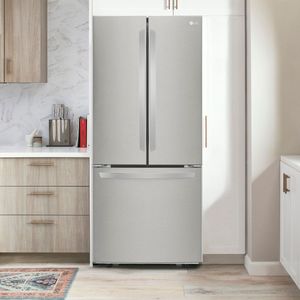
Rounding out the list is this LG French door refrigerator, which fits nearly 22 cubic feet into a 30-inch opening. That matters if your cabinetry will not accommodate a 36-inch unit. Wi-Fi connectivity lets you check and adjust temperatures from your phone and alerts you if a door is left open. Two separate crisper drawers let you store produce with different humidity needs without everything wilting together. Reviewers consistently note how quietly it runs, which is worth attention in an open-plan kitchen.
Top Features
- Smart Wi-Fi Control: Monitor and adjust temperature settings remotely from your smartphone.
- Dual Crisper Drawers: Separate produce storage reduces spoilage and food waste.
- 30-Inch Footprint: Delivers large-capacity storage in a narrower cabinet opening.
⭐ Featured LG Refrigerator #LFCS22520S Review:"It is working great, runs so quietly. I like the internal layout for storage. It is handy being able to use two doors to store smaller items like ketchup and mustard. I like the bottom drawer for cheese and lunch meat storage."
Address Your Refrigerator Leak Immediately
One of the costliest mistakes a homeowner makes is waiting on a leak, whether it comes from a sink, a washing machine, or a refrigerator. The moment you notice water inside the cabinet, identify the source and either fix it or call a technician. Acting fast is the difference between a free drain flush and replacing a section of subfloor.
If your refrigerator is beyond repair, the next step is to visit East Coast Appliance. Our team will help you find a suitable fridge replacement that fits your budget, your capacity needs, and your cabinet opening, without any pressure.
Read more:
- Frigidaire Dishwasher Not Draining? Common Problems
- Refrigerator Replacement Parts to Fix Your Fridge
- How To Get Rid of Smell In Fridge: Fridge Deodorizer
Frequently Asked Questions About Refrigerator Leaks
A clogged defrost drain is the most common cause, since blocked meltwater backs up into the fresh food compartment instead of draining to the pan below. A worn door gasket, a cracked drain pan, a leaking ice maker line, or incorrect temperature settings can all produce the same symptom.
Unplug the unit, locate the small drain opening at the back of the freezer floor, and flush it with warm water using a turkey baster or squeeze bottle. If ice has sealed the tube completely, let the freezer thaw for several hours first, then flush until water runs freely into the pan below.
Close the door on a dollar bill and pull it out. Strong resistance means the seal is good, while a bill that slides free easily indicates a failed section. Test several points around the frame, especially the lower corners where gaskets wear out first.
Yes. The pan is designed to hold defrost water until the compressor's heat evaporates it, so some water is expected. A pan that is overflowing, cracked, or knocked out of position beneath the drain outlet is the actual problem.
Set the fresh food compartment to roughly 37°F and the freezer to 0°F. Settings colder than that create excess frost that can overwhelm the defrost drain, while warmer settings in the fridge encourage condensation on interior surfaces.
Age is the deciding factor. Units under ten years old are usually worth repairing, particularly when the cause is a drain clog or a gasket. Past ten to twelve years, components tend to fail in sequence, and the cost of repeat repairs plus higher energy use often exceeds the price of a new unit.
Yes, and it often does before anyone notices. Water escaping from a cracked drain pan or a loose supply line runs behind and under the unit, where it can warp hardwood, lift laminate, and encourage mold growth in the subfloor. Dry the area completely and address the source right away.
Why Trust East Coast Appliance?
Locally owned and operated since 1988, East Coast Appliance is the largest independent appliance dealer in Virginia. We sell it ALL, from new name-brand appliances to scratch-and-dent appliances to our own refurbished units. Beyond a huge selection of every major brand and everyday low prices, what sets us apart is that we service what we sell, with factory-trained associates who work on these machines every day.
If you are local, here is the best part: East Coast Appliance is committed to the absolute lowest price on the same available brand and model. Bring in a local competitor's ad while the lower price is in effect and you will receive your price match.
Shop Quality Refrigerators at East Coast Appliance
There is a reason we are dubbed "The Discount King." For unbeatable deals, shop refrigerators online at East Coast Appliance. Our friendly associates are always happy to help you find the best refrigerator replacement for your kitchen, whether you call us or use our online chat feature. Better yet, stop by one of our showrooms to see why we are the best appliance store in Virginia. Visit us today!